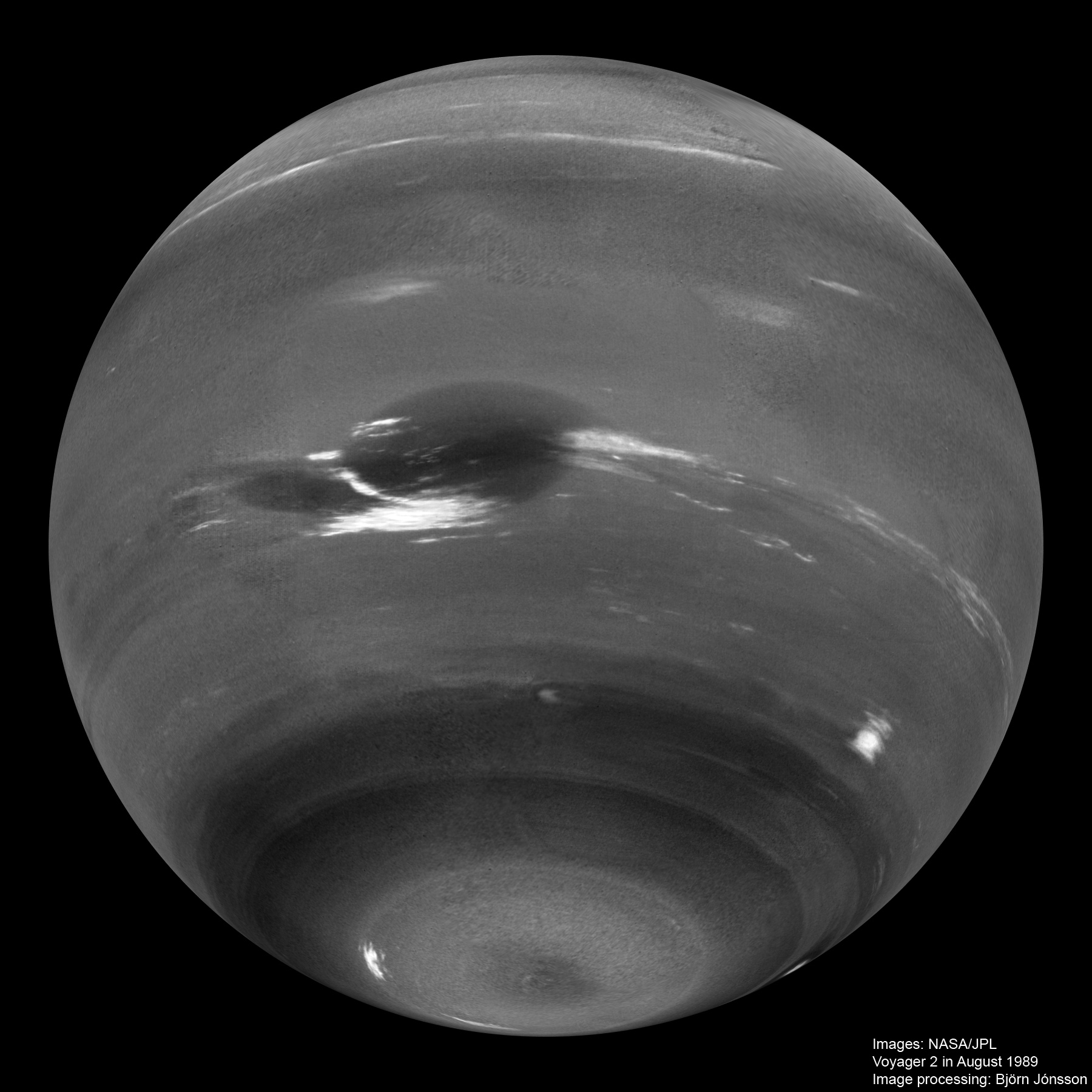
Voyager 2 Neptune Images – Global mosaic including Great Dark Spot
Global mosaic including Great Dark Spot
A high resolution global mosaic of Neptune (but see the processing description below - maybe it can be argued that this image is in the gray area between mosaics and computer generated images/simulations).
There are two versions of the mosaic, a color version and a monochrome version where the contrast has been greatly exaggerated and the effects of global illumination removed.
The image processing was not trivial. Voyager 2 usually had to transmit everything to Earth in real time. At the low bit rates possible from Neptune's distance from Earth this meant a long time between successive images. This makes assembling mosaics of Neptune difficult since the images that must be used are obtained over a period of many hours (or even a few tens of hours for big mosaics) and Neptune rotates fast. The best way for assembling big Neptune mosaics is to reproject the images to simple cylindrical projection as I typically do when doing mosaics of Jupiter or Saturn. But in addition I had to remove the effects of global illumination using an inverse photometric function when reprojecting the images, otherwise seams in the map can't be removed with acceptable result. In contrast, this is not the case when dealing with Jupiter or Saturn. I then assembled a mosaic in simple cylindrical projection and then rendered images of Neptune using the appropriate photometric function. This results in some photometric innaccuracies (the photometric function isn't 100% accurate) but despite this the resulting global images are much better than what one gets by using the source images directly since the illumination conditions change fast due to Neptune's fast rotation. All of this was done in grayscale as only green and clear filter images were available. I used mainly green images since they had better contrast than the clear filter images.
In addition to the complications mentioned above, some of Neptune's atmospheric features change very fast (especially the bright clouds) and also the rotation period (or zonal winds) varies a lot with latitude. Major features can drift over 60° in longitude during one rotation of the planet. Because of this the relative longitudinal positions of the cloud features are only approximate in the mosaics above.
The final step was to colorize the grayscale renders. For that I used an earlier global color image I assembled back in 2009.
With all of the caveats above, the result is the highest resolution global mosaics of Neptune that I have seen.
Most of the source images I used were obtained about 2 to 3 days before closest approach when Voyager 2 was 3 to 4 million km from Neptune. I used the calibrated and geometrically rectified images available at the PDS Planetary Rings Node. I used about 20 images.
Colorized global mosaic
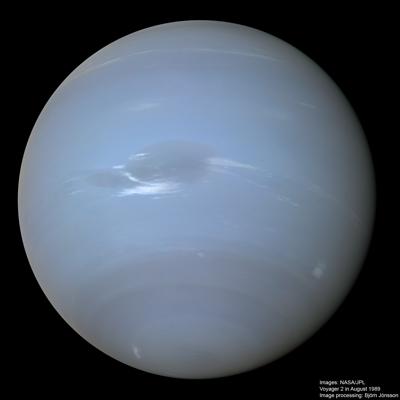
This version of the mosaic is colorized from lower resolution wide angle images.
Enhanced contrast
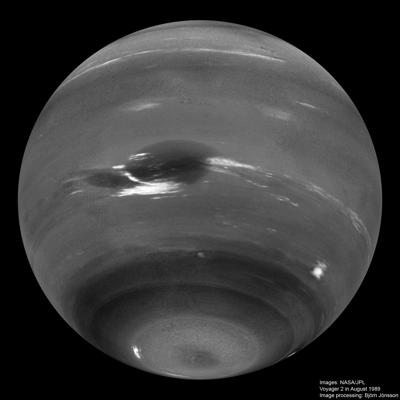
A contrast enhanced version of the monochrome mosaic.
Click any thumbnail to view the full-size image. Full-size versions may be much larger than the thumbnails.