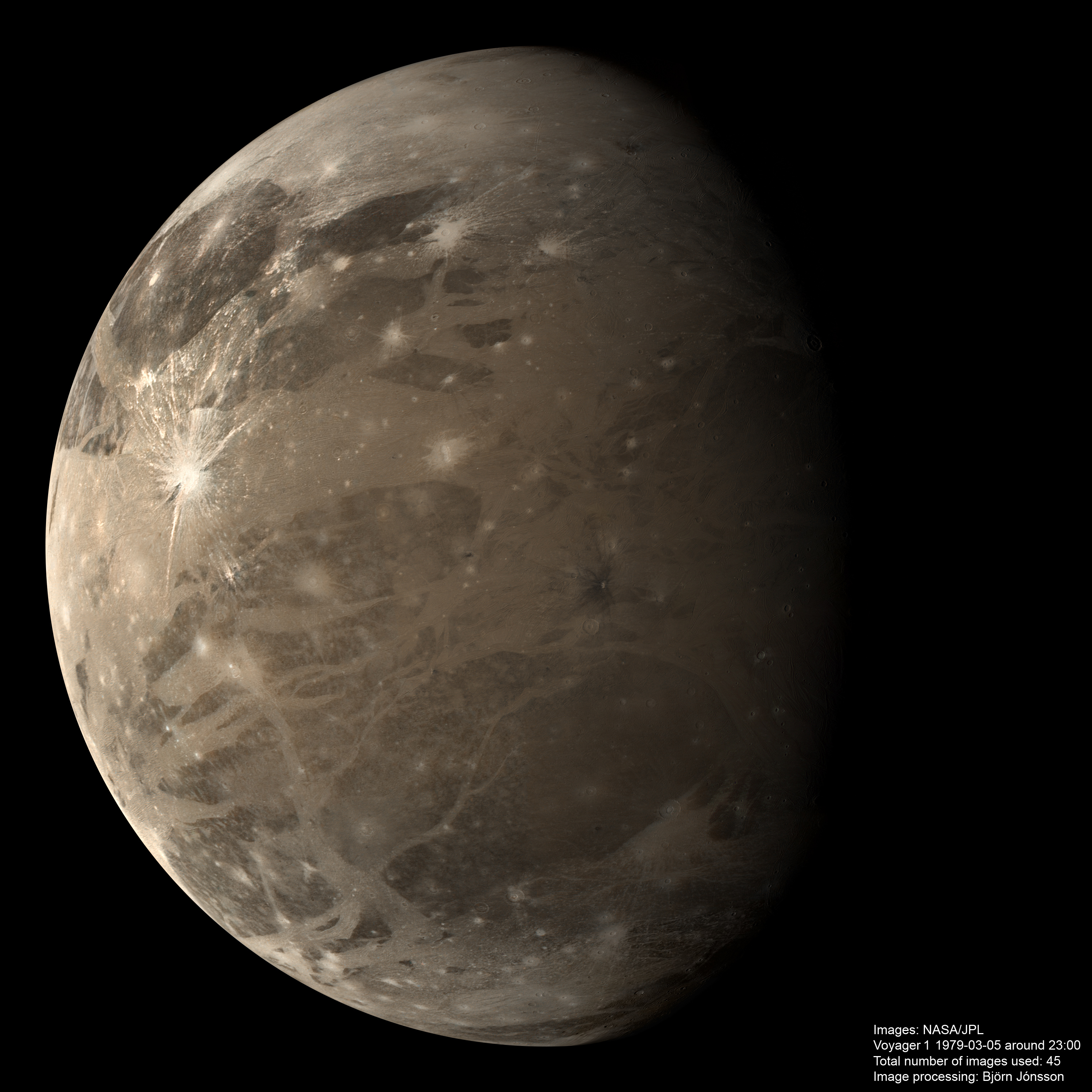
Voyager and Galileo Ganymede Images – Ganymede global mosaic (Voyager 1)
Ganymede global mosaic (Voyager 1)
A 17 frame global mosaic of Ganymede from Voyager 1 images. This is the biggest global mosaic of Ganymede I have seen. The source images were obtained by Voyager 1 on March 5, 1979 over a period of about 2 hours. During these 2 hours Voyager 1's distance from Ganymede dropped from 305,000 to 180,000 km. As usual I reprojected the original images to simple cylindrical projection, did all of the color and mosaicking work there and then rendered the resulting map with 3D software using a typical viewing geometry. Most of the 17 cylindrical maps that I created and then mosaicked are in green-blue-violet (GBV) or orange-blue-violet (OBV) color. From this I created synthetic red, green and blue (RGB) color, resulting in approximately true color (the color difference between the equatorial and polar areas should probably be more pronounced though). Somewhat unexpectedly, when making the R, G and B color it didn't seem to make any difference if the source images were OBV or GBV. In a few small areas only one or two colors were available. I colorized these areas by taking the color from nearby areas.
A significant problem when making this mosaic is that some of the source images are smeared. This happened because the intense radiation in Jupiter's magnetosphere affected Voyager 1's computers and clock. As a result some of the images were taken when the instrument scan platform was moving. It is difficult to make a full color global mosaic without using some of these smeared images. Fortunately it turned out that these images can be successfully deconvolved, making it possible to use them.
Click any thumbnail to view the full-size image. Full-size versions may be much larger than the thumbnails.